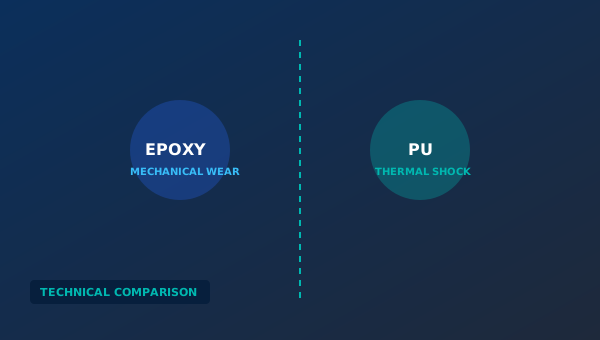
While epoxy provides unmatched tensile hardness and compressive strength for mechanical loading, polyurethane screeds excel in thermal shock environments where temperatures swing from boiling water washdowns (+100°C) to blast freezing (-25°C). Learn how our engineering team specifies the right chemistry based on chemical contact hours, mechanical impact, and facility maintenance protocols.
The Chemical Mechanism Behind Surface Delamination
Osmotic blistering occurs when residual moisture in the base concrete slab dissolves water-soluble salts within the capillary pore network, creating a hypertonic saline pocket. As ambient temperatures fluctuate, hydrostatic pressure accumulates beneath non-breathable resin films.
"Hydrostatic osmotic pressure beneath an unprimed epoxy film can readily exceed 15 to 20 N/mm²—easily surpassing the 1.5 N/mm² tensile pull-off capacity of standard M25 concrete, shearing the resin layer clean off the slab."
— FloorSathi Polymer Engineering Whitepaper Series (Issue 24)
When the tensile capacity of concrete is breached, the adhesive failure exhibits concrete aggregate fracture adhering to the backside of the peeled epoxy. This confirms that the resin did not lose adhesion to the surface; rather, the concrete substrate tore apart under hydraulic vapor shear.
ASTM & International Testing Criteria
Prior to laying any thermosetting resin matrix, our on-site engineering team conducts quantitative moisture and substrate soundness diagnostics complying with the following benchmarks:
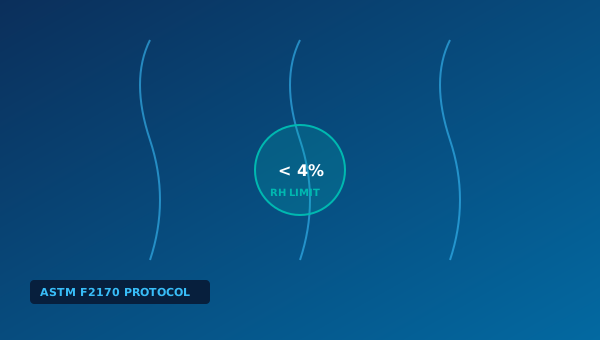
| ASTM F2170 |
In-situ Relative Humidity (RH) Probe at 40% slab depth |
≤ 80% RH Safe Threshold |
| ASTM F1869 |
Anhydrous Calcium Chloride Vapor Emission Test |
≤ 3.0 lbs / 1,000 sq ft / 24 hrs |
| ASTM D4541 |
Hydraulic Tensile Pull-Off Adhesion to Concrete |
> 1.5 N/mm² (Cohesive Failure) |
| ICRI 310.2R |
Concrete Surface Profile (CSP) Mechanical Preparation |
CSP 3 to CSP 4 (Shot-Blasted) |
Engineering Mitigation & Barrier Chemistry
When moisture audits indicate slab relative humidity exceeding 80% RH or calcium chloride emissions surpassing 3 lbs, standard epoxy primers will fail. FloorSathi implements a multi-tier damp-proof membrane (DPM) protocol:
Penetrating DPM Primer
Two-component 100% solids low-viscosity epoxy that reacts inside capillary pore moisture, creating an impermeable crystalline barrier up to 98% RH.
Polyurethane Screed Alternative
Water-based cementitious polyurethane systems that possess breathability, allowing moisture vapor transmission without blister formation.
By combining captive dustless shot-blasting with high-solids moisture mitigating primers, industrial plant heads achieve permanent, maintenance-free adhesion backed by written 5-to-10 year warranty terms.